
“The desire to create artificial life has existed for as long as we have imagined the future,” says contemporary ceramic sculptor Max Lehman. “From the earliest works of science fiction to today’s rapid advances in artificial intelligence, robots and androids have served as reflections of our hopes, fears, and our enduring curiosity about what it means to be human.”
In his upcoming show at Hecho a Mano, Lehman delves into the nuances of artificial life and its legacy. While a robot is a machine engineered to perform specific tasks, he says, “an android is something more ambiguous—a being designed in our own image.” It may be mechanical, biological, or a synthesis of both. It occupies the uncertain space between object and organism, between tool and companion, between invention and life. Artificial intelligence brings questions once reserved for science fiction into everyday conversation — we now ask whether machines can create, whether they can think, and whether they might one day become conscious.
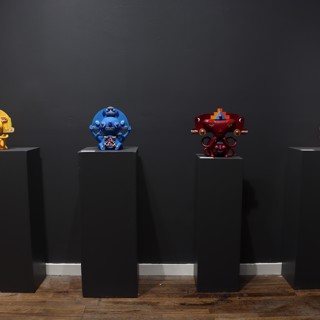
“Artists understandably worry about AI appropriating their ideas,” Lehman says. “My own work, however, remains deeply rooted in the physical act of making — there is still no machine that can throw a ceramic vessel with the intuition, hesitation, and accumulated experience of human hands. Clay continues to preserve evidence of the maker in ways that cannot be simulated.”
These ideas form the foundation of his latest series, Ancestral Androids. As Lehman points out, science fiction has often imagined machines awakening to self-awareness: William Gibson’s Neuromancer explored artificial intelligences struggling against the limits imposed by their creators, while Gary Numan’s album Replicas imagined a society where “Machmen” had replaced humanity itself. “These stories continue to resonate because they ask questions we are still unable to answer,” Lehman says: “What is consciousness? Can it be engineered? If intelligence can be manufactured, can memory, empathy, or even something resembling a soul emerge as well?”
The title Ancestral Androids poses a different question, and a different kind of world-building. The idea that an android has ancestors suggests that it has inherited more than technology — it implies history, myths, traditions, forgotten generations, and artifacts left behind by those who came before. “I imagine these sculptures as discoveries from that distant future,” Lehman says. “They are not futuristic prototypes but ancient objects. Their function has been forgotten. Their makers are gone. Time has worn away certainty, leaving only fragments from which stories can be reconstructed. They exist somewhere between relic and machine, artifact and fossil. Like objects recovered from an archaeological excavation, they invite speculation rather than explanation.”
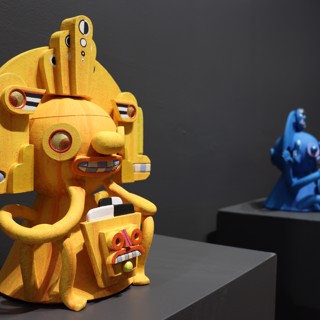
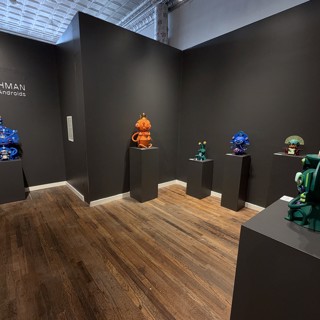
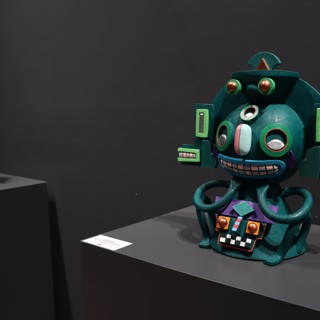
Lehman sees ceramic as uniquely suited to this fiction because it is one of humanity’s oldest surviving materials. Thousands of years after civilizations disappear, pottery often remains. By using clay to construct imagined technologies, Lehman collapses distant futures and distant pasts into the same object. The sculptures become evidence of a civilization that has not yet existed, while appearing as though they have already survived it.
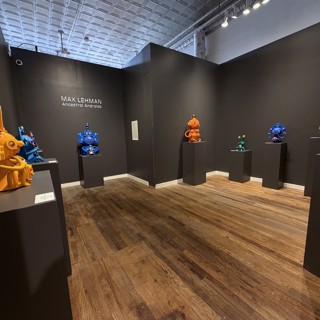
For Lehman, each sculpture begins with a story — some originate in dreams, others in memories of childhood toys, comics, science fiction, and machines that captured his imagination long before he understood how they worked. Those memories become intertwined with imagined histories until each piece feels less like something invented than something uncovered. “I resist providing complete explanations because archaeology rarely offers certainty,” Lehman notes. “We reconstruct civilizations from fragments, projecting ourselves into the spaces left empty by time.” These sculptures function in the same way — each viewer brings their own memories, experiences, and questions to the work, completing stories that remain intentionally unfinished. “Ultimately, Ancestral Androids is less about predicting the future than imagining its past,” Lehman says. “The sculptures ask us to consider what happens when artificial beings become old enough to have ancestors, old enough to leave ruins, and old enough for their own history to become myth.”