
In Jaydan Moore's work, there are no lost objects — only those given new histories. Born into a family of fourth-generation tombstone makers in Northern California whose family business doubled as a rental storage unit, Moore spent much of his childhood listening to family members making burial arrangements for their loved ones and rummaging through the abandoned artifacts left behind by other people. These early experiences left him with a life-long fascination with the significance of objects as markers of the most meaningful aspects of human experience.
Today, Moore has alchemized that obsession into a unique artistic practice: the creation of works made from deconstructed and reassembled silver-plated tableware. To Moore, these objects hold a special significance. Metal objects tend to outlive their owners, carrying with them a record of their daily use by the dings, scratches and patination they accumulate. Moore's work explores how the past lives on in these objects, even after they have been scrapped, melted, and cast into something new.
In Miscellanea, he continues this exploration, but with a fresh twist: a focus on small-scale works. "While my research to date has examined culture as a collective experience, this exhibition will shift that focus to the individual experience," Moore says. "I am interested in this idea of heirlooms on a shelf—a quilt square, a wooden box, a collage, or a print; how these objects accumulate over time to form broader cultural meaning."
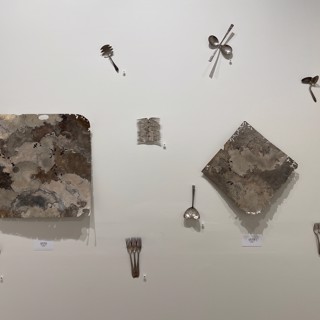
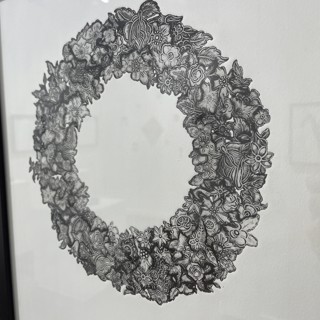
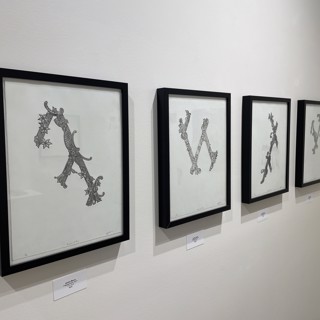
His work in this show has been influenced by the book Memory: Histories, Theories, Debates edited by Susannah Radstone and Bill Schwarz, which explores how the value of memory has shifted throughout cultural history. "As I move through this book, I am thinking about the changing cultural significance of the silver plated platters I use in my work and how they have carried meaning for their previous owners," Moore says. "Over time, these objects act as symbols for personal and collective memories. Objects can’t talk and much of that meaning is lost when they are discarded or donated to secondhand shops." His work in this exhibition explores the different ways we attach memory to the heirlooms and everyday objects we keep in our homes, and how those meanings evolve or disappear as the objects change hands.
"I am interested in this idea of heirlooms on a shelf—a quilt square, a wooden box, a collage, or a print; how these objects accumulate over time to form broader cultural meaning."
The very materials Moore uses to craft his works are steeped in memory. Many of the silver-plated platters are sourced from thrift stores, estate sales, and eBay, as well as a network of people who reach out to the artist to donate their families' platters and silver-plated items. "These objects hold a timeline of what metal and tableware has meant to our American society," Moore says. "My hope is that these pieces that are donated to me can live on in another life form through the work I make."
In the past, Moore's work has adhered to a fairly strict process: the first step is to collect the number of platters he will need for the project, then spends time carefully sketching and planning each piece, thinking through how to build each one as efficiently as possible. In this exhibition, Moore has taken a step back from that structure, allowing the work to develop more freely. Rather than planning the form of each piece in advance, he began each piece without a clear image in mind, sketched along the way, and allowed the forms to reveal themselves through the process. "I see this exhibition as an opportunity to explore new possibilities within a material I have been working with for more than ten years, and to push beyond the methods that have become familiar to me," Moore says. "Working in this material is like having a ten-year relationship, I know its quirks — I’m looking to see how I can expand on that understanding and get uncomfortable with a comfortable material."
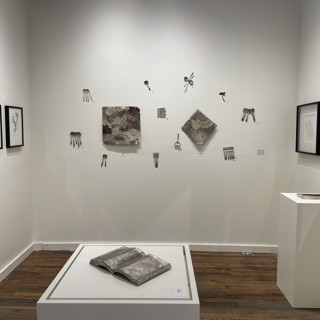
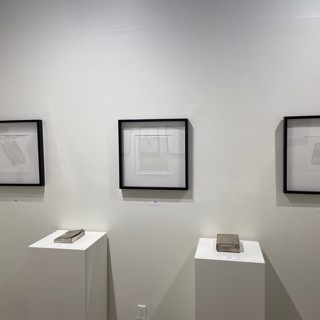
Moore's work traces the way an object moves through the world, its significance shifting with each context it inhabits. It also invites viewers to consider how their own memories may be stored in the objects of day-to-day life, and how they keep a subconscious record of their owners' lives. Each piece Moore creates is a representation of what heirloom objects mean to our society, and, if you look closely, each bears witness to past incarnations.
Miscellanea will open at Hecho a Mano on Friday, May 1, and will be on view through May 31, 2026.