
When war, displacement, and migration sever familial and cultural ties, how do we sustain a sense of self and ancestral connection? How do we hybridize in a new homeland? Printmaker Annalise Gratovich’s graphic iconography employs symbols of personal and cultural identity, signaling togetherness through a scattered Ukrainian diaspora.
Her upcoming show at Hecho a Mano features a cycle of eight life-sized woodcuts inspired by the flight of her father and his parents from Ukraine during WWII. “My family left Ukraine in the night saving only what they could carry,” Gratovich says. “What was lost or left behind has become a source of mystery and mythology, and through printmaking, I investigate how this absence influences my sense of self and how I value materiality.”
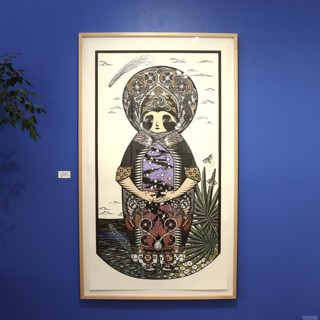
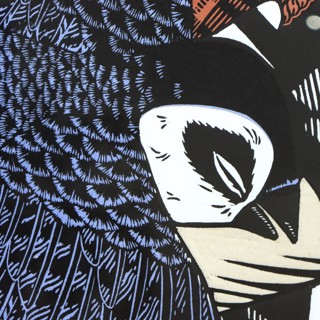
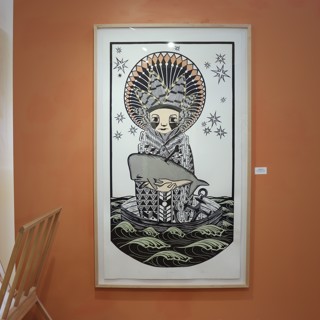
The figures in her work are totemic beings that explore personal and cultural identity; vessels based on the form of the stacking matryoshka doll. They are adorned in textiles and patterns informed by Indigenous Ukrainian textiles, embroidery, and ceremonial dress, as well as vintage American western wear. “The patterns are used to allude to distant homelands- places that are lost or cannot be returned to,” Gratovich says. Flora and fauna of the American South and Southwest adorn and surround her figures, rooting them in place and symbolizing interdependency, resiliency, and generational survival.
Her hand-carved woodcuts take months to complete, and are then meticulously colored with hand-dyed papers — a process that can take more than a month. She prints these by hand at Flatbed Press in Austin, Texas with a team of three to four other printers. The process of dyeing and cutting the paper to adorn these prints with color is evocative of traditional arts of Ukraine including the dyed egg (pysanky), and slavic papercuts (vytynanky).
The last two figures in the series, The Healer (2023) and The Fool (2025) have 60 and 70 pieces of dyed paper per print, respectively. Her experimental relief and chine collé process evokes the making of textiles through patterning, cutting, dyeing, and assembling. “I have formulated a system using specific lightfast pigments and papers that maintain integrity throughout rigorous dyeing and printing,” Gratovich says. “I train four printers for the scale and scope of editioning — two teams of two printers work continuously, inking the block and preparing the paper, in order to pull a successful print.”
The process and ethos of printmaking is intrinsic to her studio practice. “By combining meticulously cut and dyed handmade papers with printed imagery, I weave together and disperse ideas that connect generations through time and place,” Gratovich says. The ritual of creating her figures in multiples allows them to travel to disparate regions, “echoing and honoring the continuous movement of peoples.”
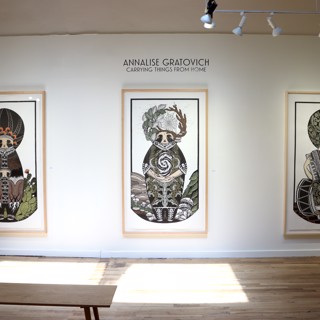
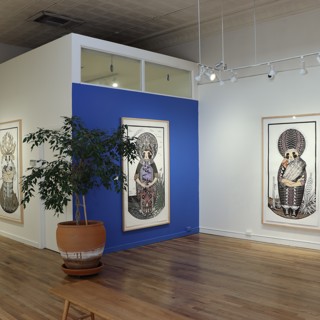
Gratovich’s totemic figures carry a strong sense of identity enrobed in the raiment of their histories, uniting the experiences of their original and new homelands. “My figures ritualistically carry in their arms symbols of their personhood and are draped in traditional Ukrainian-inspired textiles that allude to far away origins,” the artist says. “In contrast to these Ukrainian indigenous motifs, South Texas flora and landscapes root my figures to new homelands, integrating my Southern identity. My practice shares stories and ancestral connections, creating community across distances.”